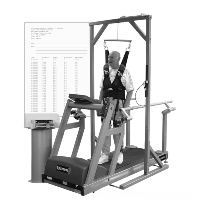
h/p/cosmos airwalk
application manual
Token fee 15.00 €
Application manual and therapy
order number [cos15128]
Team of authors
This application manual has been developed in cooperation between h/p/cosmos sports & medical gmbh, Mrs. Silvia Kollos and
Prim. Univ. Doz. Dr. Thomas Bochdansky.
© 2005 h/p/cosmos sports & medical gmbh Errors and omissions exepted. All rights reserved.
Treadmill-Ergometer
The treadmill-ergometer used in this application manual in connection with the h/p/cosmos airwalk is the h/p/cosmos mercury med 4.0 with the option adjustable handrails. The shown h/p/cosmos airwalk 70 needs comressed air or a compressor.
Development, Production, Sales & Service
h/p/cosmos sports & medical gmbh
Am Sportplatz 8
DE 83365 Nussdorf-Traunstein Germany
phone +49 / 86 69 / 86 42 0
fax +49 / 86 69 / 86 42 49
email@h-p-cosmos.com www.h-p-cosmos.com
LN
h/p/cosmos sports & medical gmbh Am Sportplatz 8 DE 83365 Nussdorf-Traunstein / Germany phone +49 / 86 69 / 86 42 0 fax +49 / 86 69 / 86 42 49 email@h-p-cosmos.com www.h-p-cosmos.com
file: l:\manuals\h-p-cosmos_airwalk\en\application\cos15128_h-p-cosmos_airwalk_application_manual_20050926.doc
© 2005 h/p/cosmos sports & medical gmbh created 26.09.2005 printed 26.09.2005 page: 1 of 40
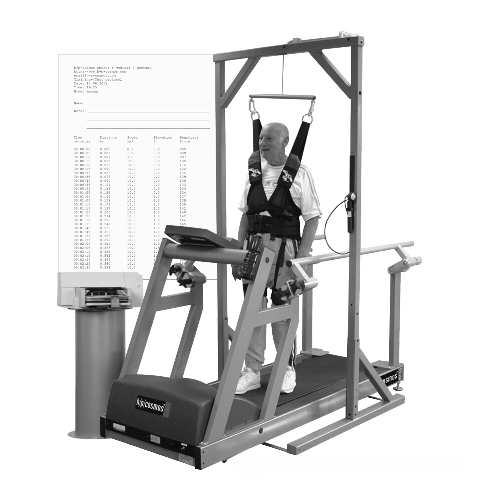
h/p/cosmos airwalk
and treadmill-ergometer h/p/cosmos mercury med 4.0 with adjustable handrails
Videos can be downloaded from the website: www.h-p-cosmos.com/en/products/airwalk
LN
fiele: l:\manuals\h-p-cosmos_airwalk\en\application\cos15128_h-p-cosmos_airwalk_application_manual_20050926.doc
© 2005 h/p/cosmos sports & medical gmbh email@h-p-cosmos.com created 26.09.2005 printed 26.09.2005 page: 2 of 40
The authors 5
Liability exemption / safety warnings 6
Devices and Materials 6
Mobility of the ankle joint 7
D1 Passive Dorsal flexion during walking 7
D2 Passive Plantar flexion 8
D3 Passive Dorsalflexion standing 8
D4 Active Dorsal flexion („Drive scooter“) 9
D5 Active Plantar flexion („the short foot“) 10
Endurance 10
E1 Accentuated walk forward („walking like a stork“) 11
E2 Accentuated walk backwards 11
Speed 12
F1 Active speed training („fast scooter driving“) 12
Coordination / Games 12
G1 Coordination walk with standing leg 13
G2 Temple hopping 14
G3 Coordination walk with Janda-Shoes 15
Mobility 16
A1 Knee mobility flexion 16
A2 Knee mobility extension 17
Endurance 17
B1 Leg axis training with the Theraband. 17
B2 Leg extension with Theraband 19
B3 Eccentric slowing down with Theraband („Frog jumps“). 19
Speed 21
C1 One-legged jump with traction 21
Coordination / Game 21
D1 One-legged jump with traction load 22
D2 Leg extension with Theraband 22
Mobility 23
A1 Hip extension and hip flexion 23
A2 „Safety-step“ 23
© 2005 h/p/cosmos sports & medical gmbh email@h-p-cosmos.com created 26.09.2005 printed 26.09.2005 page: 3 of 40 LN
Endurance 25
B1 Walking backwards. 25
B2 Lateral walking 26
Coordination / Game 26
C1 Lateral one-leg standing 26
C2 One-legged coordination training with adhesive tape. 27
Strength training 28
Endurance 29
Coordination / Game 29
Mobility 31
Power / Coordination 32
B1 Therapy exercise 1 32
B2 Therapy exercise 2 33
B3 Therapy exercise 3 33
Endurance 34
Technical service 40
Sales and Consultation 40
Headquarters of the company 40
© 2005 h/p/cosmos sports & medical gmbh email@h-p-cosmos.com created 26.09.2005 printed 26.09.2005 page: 4 of 40 LN
This manual shows you the application fields of the h/p/cosmos airwalk in therapy. Of course the list of exercises is not complete. It merely shows examples and gives suggestions for individual variations in therapy. Every therapist can and will discover a wide range of individual variations and new exercises in their daily work.
For the patient the advantages of the h/p/cosmos airwalk in therapy are the fall prevention and unweighting. The h/p/cosmos airwalk offers maximum safety for both patient and therapist. As the patient is secured in the system, the therapist can concentrate fully on his work. Therapies with the h/p/cosmos airwalk allow for an essentially wider sphere of action through the unweighting and the fall prevention.
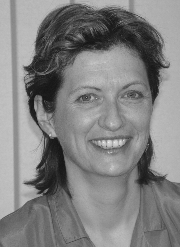
Silvia Kollos, born 1958 in Baden near Vienna, visited the school for the physiotherapeutic service at the University clinic Vienna (AKH) and obtained her diploma there with distinction.
After two years at the neurological University clinic Vienna (AKH) she took over teaching at the same place in 1982. In 1983 she went to Vallejo, California, USA to participate in a six-month PNF-education at the Kaiser Foundation Rehabilitation Centre.
Until 1992 Mrs. Kollos worked as a teaching assistant with diploma at the academy for physiotherapy at the University clinic Vienna, before opening up her own practice with focus on sports-physiotherapy.
During this time she attended to successful teams and individual athletes, such as the Olympic sailing team, the Austrian Volleyball champion, the Ice hockey team WEV or the female inline-skating world champion.
With numerous training courses in PNF, Bobath, Schroth, Manual therapy, Sports-physiotherapy, Brügger, Lymph- drainage, foot reflexology massage, sensomotoric training after Janda, Sling-exercise-therapy (SET) and a special education course for dipl. teaching assistants she is constantly extending her knowledge.
Currently she is in the middle of her master studies (advanced studies health and fitness) at the Institute of Sports sciences of the University Salzburg / Austria.
Various teaching assignments at physio- and ergo therapy academies, nursing schools and masseur training courses determine her field of activity nowadays as well as numerous talks at congresses and publications (e.g. as a book author „Rehabilitation program after knee surgery, published by Springer. Since 2002 Mrs. Kollos also manages the national special education for sports-physiotherapy.
© 2005 h/p/cosmos sports & medical gmbh email@h-p-cosmos.com created 26.09.2005 printed 26.09.2005 page: 5 of 40 LN
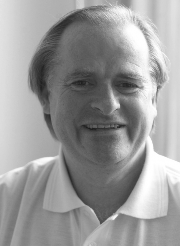
Prim. Univ. Doz. Dr. Thomas BOCHDANSKY was born in Vienna in 1951. After his successful studies at the University of Innsbruck / Austria he joined the former institute for physical medicine of the University Vienna as an intern in 1981 and obtained the medical specialist licence in 1985.
In 1989 he was given the internal-medical management of the University clinic for physical medicine and rehabilitation in Vienna and he became planning commissioner for the new AKH in Vienna. From 1994 till 1996 he worked as an assistant medical director at the rehabilitation centre
„Weisser Hof“ of the AUVA, Klosterneuburg / Austria.
In the year 1995 Dr. Bochdansky habilitated in the field of physical medicine („The assessment of muscle power at concentric and eccentric contraction“). From 1996 till 1999 he then took over the medical management of the institute for physical medicine in Brigittenau / Vienna (Austria).
Since October 1999 Dr. Bochdansky is the medical director of the physical medicine and rehabilitation department at the hospitals in Rankweil and Feldkirch / Austria. His current research focus is the analysis of muscle functions in reference to physio- and ergo therapeutic applications as well as the motion analysis/ gait analysis and rehabilitation documentation.
The h/p/cosmos sports & medical gmbh and the authors do not undertake any liability for damages to persons or devices, which are connected with the applications shown herein. Read and comply with all safety notice and warnings of the unweighting system, the treadmill ergometer and all other equipment and accessories used as described and stated in the individual operation manuals and warning of the individual devices and accessories.
Treadmill-Ergometer: h/p/cosmos mercury med 4.0 with adjustable handrails and unweighting- and safety system h/p/cosmos airwalk 70 with compressor (alternatively with pneumatic connection).
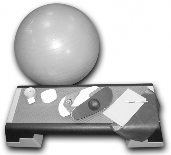
N Aerobic step
N Gymnastics ball
N Janda shoes
N Theraband – different strengths (colours)
N Laserpointer
N Velcro-/adhesive tape N Smith & Nephew tape N Two handbags o.s.
© 2005 h/p/cosmos sports & medical gmbh email@h-p-cosmos.com created 26.09.2005 printed 26.09.2005 page: 6 of 40 LN
Walking speed, unweighting and exercise duration are selected individually depending on the patient, the injury and the therapy goal.
Generally following areas can be recommended for exercises for the mobility of the ankle joint:
N Speed: 0.3 – 0.5 km/h
N Exercise duration: approx. 3 – 5 min
N Unweighting: according to load capacity decrescent (= safety)
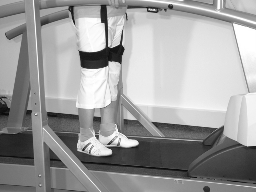
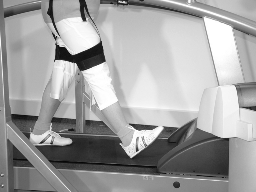
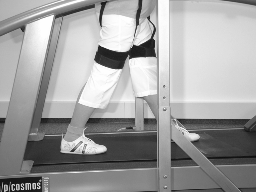
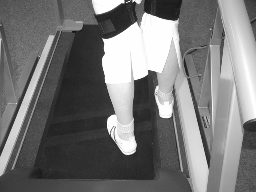
Exhausting the maximum possible mobility of the ankle joint / accentuated ankle joint mobility in the normal gait pattern
Starting position
Eyes looking against the running direction of the running belt, both feet on the running belt, both hands on the handrails at the side
Execution
N Bring the heel of the affected leg actively well forward, actively pull up the front part of the foot
N The foot runs backwards with the running belt, the heel stays on the running belt as long as possible
N Repeat with the next step
© 2005 h/p/cosmos sports & medical gmbh email@h-p-cosmos.com created 26.09.2005 printed 26.09.2005 page: 7 of 40 LN
Training goal
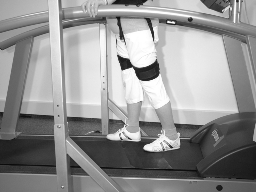
Passive mobility in the plantar flexion
Starting position
Eyes looking with the running direction of the running belt (back towards user terminal), the healthy leg stands on the side plate of the treadmill next to the running belt, both hands on the side handrails
Execution
N Put the heel of the affected leg actively backwards
N The leg runs forwards with the running belt, the toes stay on the running belt actively as long as possible
N Repeat with the next step
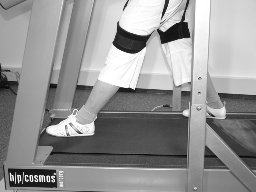
Exhausting the maximum possible mobility of the ankle joint and the passive mobility of the dorsal flexion
Starting position
Eyes against the running direction of the running belt, the healthy leg stands on the side foot plate of the treadmill next to the running belt, both hands on the side handrails
© 2005 h/p/cosmos sports & medical gmbh email@h-p-cosmos.com created 26.09.2005 printed 26.09.2005 page: 8 of 40 LN
Execution
N Put the heel of the affected leg actively forward
N The foot runs to the back with the running belt, the heel stays actively on the belt
N Repeat with the next step
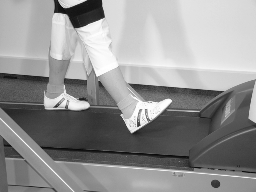
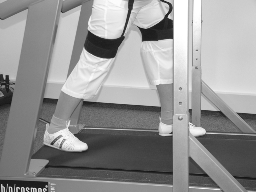
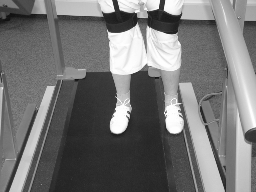
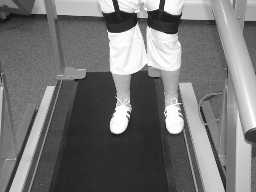
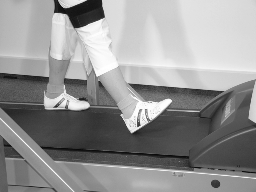
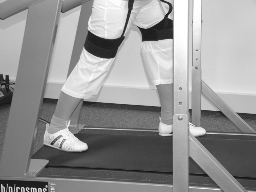
Force the passive mobility and strengthening of the dorsal flexion, develop the unroll movement
Starting position
Eyes against the running direction of the running belt, the healthy leg stands on the side foot plate of the treadmill next to the running belt, affected leg on the running belt, both hands on the side handrails
Execution
N Put the heel of the affected led actively forward
N The foot runs backwards with the running belt, the heel stays actively on the running belt as long as possible and the patient tries to accelerate the running belt with the toes
N Repeat with the next step
© 2005 h/p/cosmos sports & medical gmbh email@h-p-cosmos.com created 26.09.2005 printed 26.09.2005 page: 9 of 40 LN
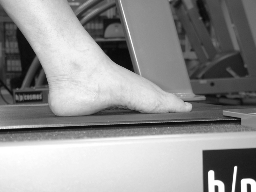
Training goal
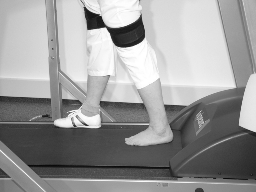
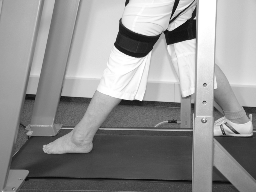
Passive mobility during active plantar flexion, „short foot“ through flexing the sole muscles while walking
Starting position
Eyes in direction of the running belt, the healthy led stands at the side foot plate of the treadmill next to the running belt, both hands on the side handrails. This exercise has to be performed barefooted.
Execution
N Put the heel of the affected leg actively backwards
N The foot runs to the front, the heel stays actively on the running belt as long as possible and the patient tries to stop the running belt with the toes
N Repeat with the next step
Walking speed, unweighting and exercise duration are selected individually depending on the patient, the injury and the therapy goal.
N Speed: 2 km/h, slowly increasing according to load capacity of the patient
N Exercise duration: approx. 20 min.
N Unweighting: according to load capacity of the patient decrescent (= safety)
© 2005 h/p/cosmos sports & medical gmbh email@h-p-cosmos.com created 26.09.2005 printed 26.09.2005 page: 10 of 40 LN
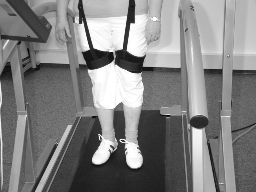
Exercise goal
Initiation of free walking, activation of various muscle groups (increase the energy consumption)
Starting position
Eyes against the running direction of the running belt, both feet on the running belt, both hands swinging loosely (don’t hold on to the handrails)
Execution
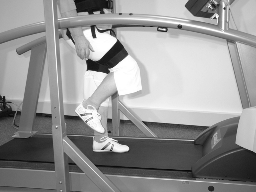
Slow, extremely accentuated walking. Press up actively from the toes and lift up the heels and knees as high as possible, swing freely with the arms.
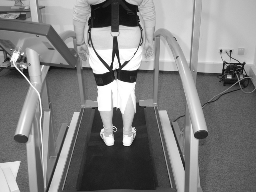
Improvement of the hip extensor muscles (= Standing leg activity)
Starting position
Eyes in running direction of the running belt, both feet on the running belt, arms swing freely (without holding on to the handrails)
Execution
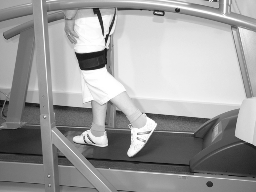
Slow backwards walking with big steps backwards. The upper body stays upright; the hips are fully extended (no sitting in the harness).
© 2005 h/p/cosmos sports & medical gmbh email@h-p-cosmos.com created 26.09.2005 printed 26.09.2005 page: 11 of 40 LN
Walking speed, unweighting and exercise duration are selected individually depending on the patient, the injury and the therapy goal.
N Speed: 4 – 8 km/h, accelerating according to load capacity of the patient
N Exercise duration: approx. 3 – 5 min
N Unweighting: according to load capacity of the patient decrescent, for safety and trunk stabilisation
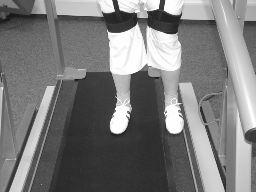
Initiation of fast walking up to running movement
Starting position
Eyes against the running direction of the running belt, the healthy led stands on the side foot plate of the treadmill next to the running belt, both hands on the side handrails
Execution
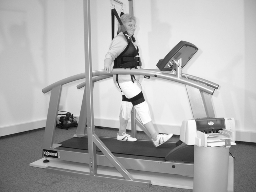
„One-leg-scooter-driving“, the step length and the speed of the treadmill determine the movement frequency
Walking speed, unweighting and exercise duration are selected individually depending on the patient, the injury and the therapy goal.
Generally following areas can be recommended for the speed development exercises:
N Speed: 1 km/h, slowly increasing depending on capabilities
N Exercise duration: approx. 3 – 5 min
N Unweighting: approx. 25 – 50% of the body weight
© 2005 h/p/cosmos sports & medical gmbh email@h-p-cosmos.com created 26.09.2005 printed 26.09.2005 page: 12 of 40 LN
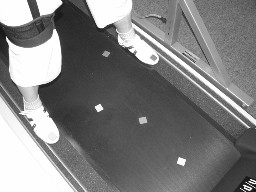
Accessories
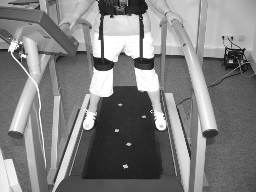
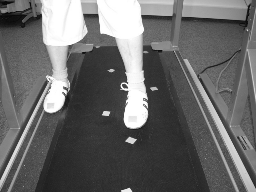
Coloured tapes / tape marks on the running belt and on the shoes in two different colours (e.g. red for the left foot, green for the right foot). For the preparation of this exercise 8 – 15 coloured tape marks are fixed to the running belt. The marks are fixed on the running belt in irregular distances of about 20 to 40 cm to each other on different positions. The tape marks have to be removed after the exercise.
Training goal
Development of the eye – foot – coordination / improvement of the passive attentiveness
Starting position
Eyes against the running direction of the running belt, always one leg on the side foot plate of the treadmill next to the running belt. At the beginning both hands on the side handrails, with increasing skill free movement of the arms.
Execution
Put the foot on the respective coloured marks of the running belt
© 2005 h/p/cosmos sports & medical gmbh email@h-p-cosmos.com created 26.09.2005 printed 26.09.2005 page: 13 of 40 LN
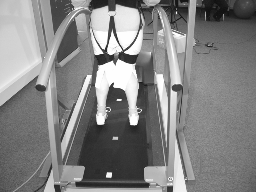
Exercise goal
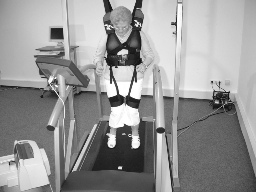
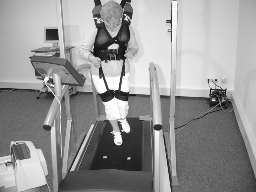
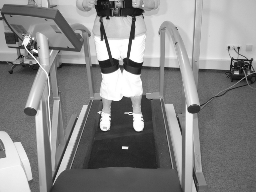
Two-footed – foot – coordination, improvement of the passive attentiveness, forced change of standing leg in preparation of every day situations
Starting position
Eyes against the running direction of the running belt, both feet on the running belt. At the beginning both hands on the side handrails but with increasing skill free movement of the arms.
Execution
One- and two-footed jumps according to the colour of the marking tapes
© 2005 h/p/cosmos sports & medical gmbh email@h-p-cosmos.com created 26.09.2005 printed 26.09.2005 page: 14 of 40 LN
N Speed: 0.3 – 0.5 km/h, slowly increasing depending on ability of the patient
N Exercise duration: ca. 3 – 5 min
N Unweighting: max. 25 % of the bodyweight
Aids
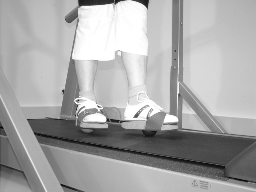
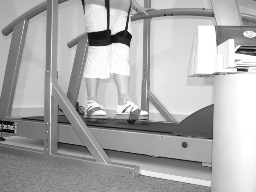
„Janda-Shoes“ (half a small ball on the sole of the shoes)
Training goal
Sensomotoric training for the foot stabilisation
Starting position
Eyes against the direction of the running belt, booth feet on the running belt, patient with Janda-Shoes. At the beginning both hands on the side handrails but with increasing skill free movement of the arms.
Execution
The patient is supposed to walk on the half ball only. Neither the toes nor the heel touch the running belt while walking. With increasing skills the unweighting can be reduced.
Variations
To increase the sensomotoric training additional tasks can be given to the patient. Examples:
N Several tennis balls are given to the patient and he has the mission to throw them into a box in front of the treadmill.
N As already described for the temple hopping the patient has the mission to step onto different marks with the Janda-Shoes.
N The patient gets different coordination tasks e.g. touch the right-side ear with the left hand and the other way around.
© 2005 h/p/cosmos sports & medical gmbh email@h-p-cosmos.com created 26.09.2005 printed 26.09.2005 page: 15 of 40 LN
Walking speed, unweighting and exercise duration are selected individually depending on the patient, the injury and the therapy goal.
N Speed: approx. 0.5 km/h slowly increasing up to approx. 3 km/h
N Exercise duration: approx. 3 – 5 min
N Unweighting: 0% of the bodyweight – significant trunk stabilisation
25% of the bodyweight – slight trunk stabilisation
50% of the bodyweight – insignificant trunk stabilisation, depending on load capacity of the patient decrescent
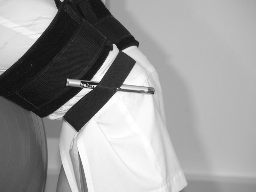
Trunk stabilisation (instruction of the „deep stabilisation“), leg axis training, knee mobility for flexion
Aids
Aerobic-Step, gymnastics ball and laser pointer. Place the aerobic-step across the treadmill like a bridge. Put the gymnastics ball on the step and sits on the ball for the execution of the exercise. The laser pointer is fixed on the outer side of the thigh near the knee with the help of a Velcro tape or adhesive tape.
Starting position
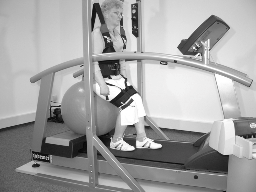
Eyes against the running direction of the running belt, patient sits on the gymnastics ball, both feet on the running belt, immediately beneath the unweighting system. The hands can rest on to the side handrails to stabilise the upper body.
Execution
The patient has to put the heel straight on the running belt in front of him while seated and to bring the leg straight back (without swerving). The laser pointer points to a pre- determined area.
During this exercise the patient has to take care always to point to the same area with the laser pointer (e.g. point on the logo on the motor hood of the treadmill).
Variations
N Patient tries to accelerate the running belt during the exercise
N Patient performs this exercise with the Janda-Shoes
N Patient sits further to the front or further to the back and therefore works with the upper body muscles against the traction of the rope
© 2005 h/p/cosmos sports & medical gmbh email@h-p-cosmos.com created 26.09.2005 printed 26.09.2005 page: 16 of 40 LN
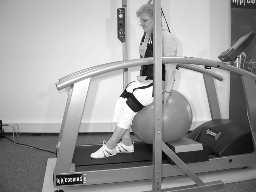
Exercise goal
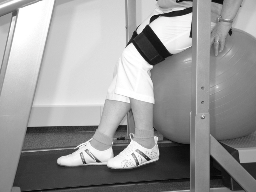
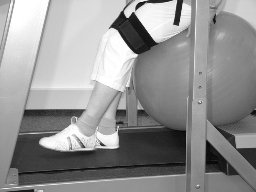
Upper body stabilisation (instruction of the „deep stabilisation“), leg axis training, knee mobility for extension
Starting position
Like in exercise „Knee mobility flexion“, but with eyes in running direction of the running belt
Execution
The patient has to place the foot on the running belt while sitting and lead the leg straight forward without any swerving.
Variations
See exercise „Knee mobility flexion“
Walking speed, unweighting and exercise duration are selected individually depending on the patient, the injury and the therapy goal.
N Speed: approx. 2 - 3 km/h
N Exercise duration: approx. 15 min.
N Unweighting: max. 50% of the bodyweight
Training of the adductors and pronation, controlled concentric and eccentric, leg axis training
Aids
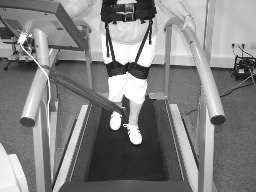
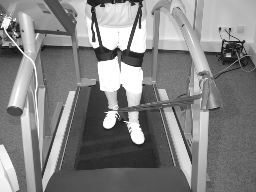
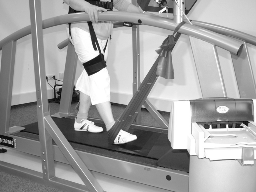
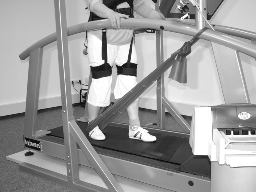
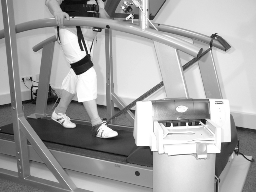
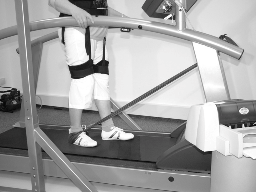
Theraband (different colours, the tension class has to be adapted individually to each patient). The Theraband is wrapped around the affected foot and fixed to the handrail.
© 2005 h/p/cosmos sports & medical gmbh email@h-p-cosmos.com created 26.09.2005 printed 26.09.2005 page: 17 of 40 LN
Starting position
Eyes against the running direction of the running belt, both feet on the running belt, immediately beneath the unweighting system. The hands are paced on the side handrails to fix the upper body. Theraband wrapped around the foot / ankle joint (affected side) and traction from the front – lateral / medial.
Execution
The patient walks on the treadmill with the Theraband wrapped around the foot / joint ankle (affected side) and while walking works against the traction from the front – lateral / medial side resp. from the top. By changing the speed the fine adjustment of the eccentric muscles can be improved. By fixing the Theraband the axis of rotation of the movement can be trained from different approach angles.
Variations
If desired the patient can also refrain from holding on to the side handrails and therefore improve the training of the stabilising muscles.
© 2005 h/p/cosmos sports & medical gmbh email@h-p-cosmos.com created 26.09.2005 printed 26.09.2005 page: 18 of 40 LN
Exercise goal
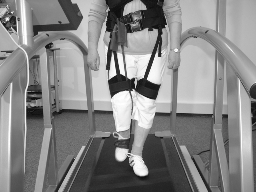
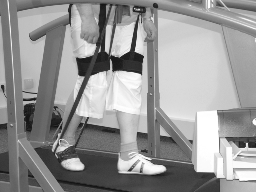
Improvement of the leg extension. Improvement of the eccentric load at controlled landing.
Aids
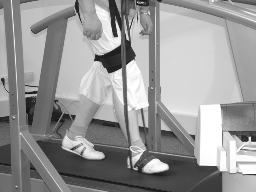
Theraband (different colours, the traction class has to be adjusted individually to each patient). The Theraband is wrapped around the affected foot and fixed to the vest at the front so that the knee is mobile.
Starting position
Eyes against the running direction of the running belt, both feet on the running belt, immediately beneath the unweighting system. The hands move freely.
Execution
The Theraband wrapped around the foot / ankle joint (affected side) and traction from the front – lateral.
Walking speed, unweighting and exercise duration are selected individually depending on the patient, the injury and the therapy goal.
N Speed: approx. 3 km/h
N Exercise duration: approx. 10 min.
N Unweighting: variable from 75% bodyweight slowly reducing
Aids
Theraband (different colours, the traction class has to be adjusted individually to each patient). The Theraband is wrapped around the affected foot and fixed to the front of the vest so that the knee is mobile.
© 2005 h/p/cosmos sports & medical gmbh email@h-p-cosmos.com created 26.09.2005 printed 26.09.2005 page: 19 of 40 LN
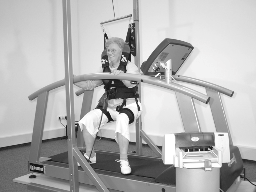
Exercise goal
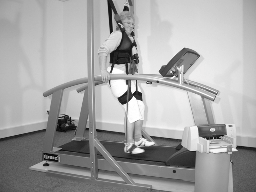
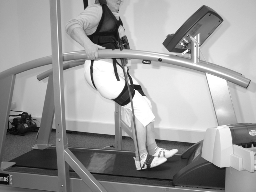
Improvement of the leg extension and the eccentric load at controlled landing under difficult circumstances. Furthermore the patient regains confidence in the load capacity of his knee through this exercise, as he can move into different movements with the help of the unweighting.
Starting position
Eyes against the direction of the running belt, both feet on the running belt, immediately beneath the unweighting system. The hands move freely.
Execution
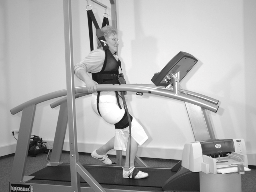
The patient has to jump up out of a squatting position. In this movement a special emphasis is place on the extension. For this the patient is asked to squat down to the back as if he was sitting down on a chair, and then to jump up and to the front out of this squatting position. In this the patient has to work against the traction of the Theraband, i.e. the legs must not touch each other during this exercise.
Variations
N This exercise can also be performed one-footed (see speed)
N To increase the effect of this exercise the patient does not only jump up to the front, but jumps 90 degree to the right or left-side (jump in a circle). This increases the level of difficulty but also the efficiency of the exercise extremely. The speed for this variation has to be set very low at the beginning (max. 1 km/h)
© 2005 h/p/cosmos sports & medical gmbh email@h-p-cosmos.com created 26.09.2005 printed 26.09.2005 page: 20 of 40 LN
Walking speed, unweighting and exercise duration are selected individually depending on the patient, the injury and the therapy goal.
N Speed: approx. 2 km/h variable increasing
N Exercise duration: approx. 2 min.
N Unweighting: variable from 50% body weight, slowly reducing
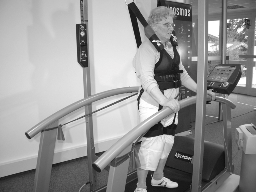
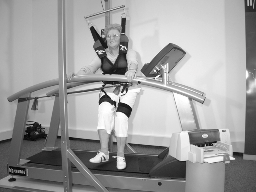
Theraband (different colours, the traction class has to be adjusted individually to each patient). The Theraband is wrapped around the pelvis of the patient and fixed to the handrail at the back of the treadmill.
Training goal
Concentric and well-measured eccentric of the knee extensor / knee stabiliser
Starting position
Eyes to the side, with the affected leg in running direction of the running belt, with both feet on the running belt, starting position directly beneath the unweighting system. Both hands on the handrails for stabilisation and safety. The Theraband is wrapped around the pelvis and fixed to the back of the handrails on both sides. Therefore the traction goes in the running direction of the running belt
Execution
The patient has the task to jump against the running direction of the running belt with the affected leg – therefore also against the traction of the running belt – and land in a controlled manner.
Walking speed, unweighting and exercise duration are selected individually depending on the patient, the injury and the therapy goal.
N Speed: approx. : 3 – 5 km/h variable increasing
N Exercise duration: approx. 5 min.
N Unweighting: variable from 50% bodyweight, slowly reducing
© 2005 h/p/cosmos sports & medical gmbh email@h-p-cosmos.com created 26.09.2005 printed 26.09.2005 page: 21 of 40 LN
Exercise goal
Concentric and well-measured eccentric of the knee extensor / knee stabiliser (divert attention from the joint)
Starting position and execution
Exercise like in „One-legged jump with traction load / Endurance“ but with laser pointer fixed to the outside of the tibia head. At landing the patient tries to aim at a certain point with the light of the laser pointer.
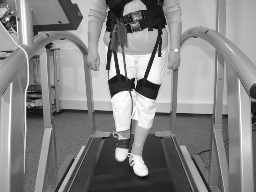
Improvement of the leg extension, improvement of the eccentric load at controlled landing. Emphasis on swinging and standing leg phase at sensomotoric obstructions through the Theraband
Aids
Theraband (different colours; traction classes have to be adjusted to each patient individually). The Theraband is wrapped around the affected foot and is fixed to the front of the vest so that the knee is mobile.
Starting position
Eyes against the running direction of the running belt, with both feet on the running belt, directly beneath the unweighting system. Hands moving freely.
Execution
The Theraband is wrapped around the foot / ankle joint (affected side) and fixed to the front of the vest. Walking and moving the knee next to the Theraband.
© 2005 h/p/cosmos sports & medical gmbh email@h-p-cosmos.com created 26.09.2005 printed 26.09.2005 page: 22 of 40 LN
Walking speed, unweighting and exercise duration are selected individually depending on the patient, the injury and the therapy goal.
N Speed: approx. 0.5 km/h
N Exercise duration: approx. 3 min.
N Unweighting: variable from 50% bodyweight
Theraband. The Theraband is fixed to the uprights of the h/p/cosmos airwalk as a kind of „obstacle“ across the running surface at about 10 cm height
Exercise goal
Secure walking, hip mobility in extension and flexion, training of contra-lateral walking with a stick
Starting position
Both feet on the running belt, eyes against running direction of belt, Theraband as the „obstacle“ across the running surface, contra-lateral hand on the handrail (or free)
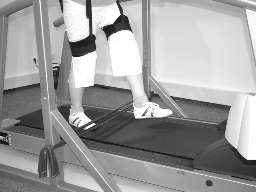
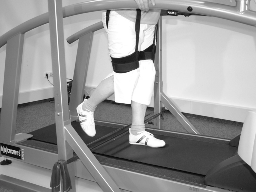
Execution
Slow walking over an obstacle, stepping over the obstacle with both feet to the front, then backwards, lifting up the feet.
Walking speed, unweighting and exercise duration are selected individually depending on the patient, the injury and the therapy goal.
N Speed: approx. 0.5 km/h
N Exercise duration: approx. 3 min.
N Unweighting: 50% of the bodyweight
© 2005 h/p/cosmos sports & medical gmbh email@h-p-cosmos.com created 26.09.2005 printed 26.09.2005 page: 23 of 40 LN
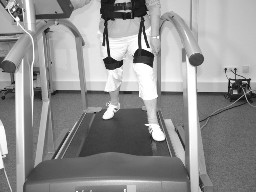
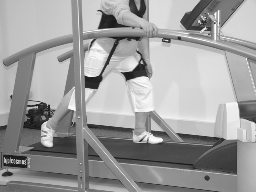
Exercise goal
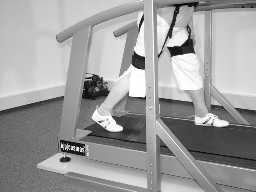
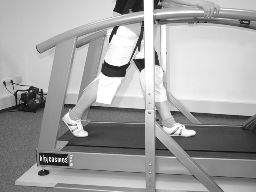
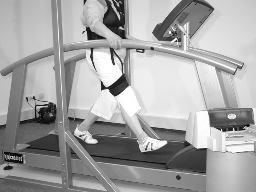
Passive extension and outward rotation or inward rotation, slow down a fall to the front (training of the fall prevention, „safety-step“), also under difficult circumstances (e.g. variation with both feet)
Starting position
Affected foot on the running belt, healthy leg on the side foot plate, eyes against running direction of belt, contra-lateral hand on the handrail (or free)
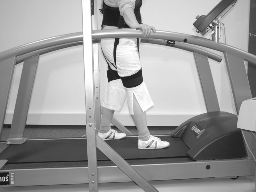
Execution
Let the leg go into extension as far as possible, and then bring back forwards quickly. Long standing leg phase in extension and then quickly back to the front (short free leg phase)
Variations
N Toes rotating outwards (see above)
N Toes rotating inwards (see right-side)
N Safety-step on both sides, i.e. with both feet on the running belt (see below)
© 2005 h/p/cosmos sports & medical gmbh email@h-p-cosmos.com created 26.09.2005 printed 26.09.2005 page: 24 of 40 LN
Walking speed, unweighting and exercise duration are selected individually depending on the patient, the injury and the therapy goal.
N Speed: approx. 0.5 km/h slowly increasing
N Exercise duration: approx. 15 min.
N Unweighting: max. 50% of the bodyweight
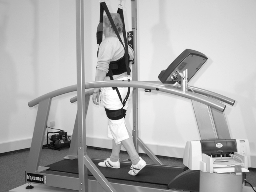
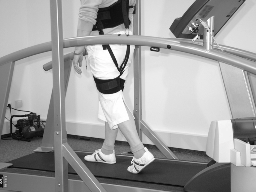
Walking backwards under different circumstances, active extension
Starting position
Eyes in running direction of running belt, both feet on the running belt, immediately beneath the unweighting system. Hands are moving freely.
Execution
The patient has the mission to walk backwards (without support and without crutches). The speed can be increased with improving skill, resp. the unweighting can be reduced.
© 2005 h/p/cosmos sports & medical gmbh email@h-p-cosmos.com created 26.09.2005 printed 26.09.2005 page: 25 of 40 LN
Exercise goal
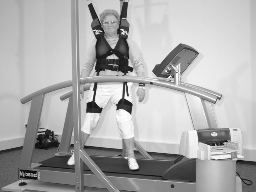
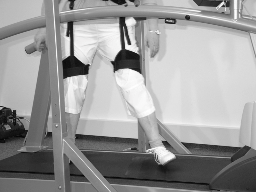
Improvement of limping through unweighting
Starting position
Position and eyes on the side with the affected hip side pointing to the front, both feet on the running belt, directly beneath the unweighting system. Hands moving freely.
Execution
Lateral walking with active pelvis stabilisation with the help of the adductors. The speed can be increased with improving skill resp. the unweighting can be reduced.
Walking speed, unweighting and exercise duration are selected individually depending on the patient, the injury and the therapy goal.
N Speed: approx. 0.1 – 0.3 km/h
N Exercise duration: approx. 2 min.
N Unweighting: max. 50% of the bodyweight – reduce slowly
Developing the feeling for the leg axis foot-hip
at „Fixed point“ at the trunk and „Mobile point“ at the foot, fast and short alternate steps
training of the abductors (fast stabilisation)
Starting position
With both feet on the running belt, facing the side and the affected leg in running direction
On the healthy side the leg cuff of the vest can be loosened to give the patient full mobility in this leg.
© 2005 h/p/cosmos sports & medical gmbh email@h-p-cosmos.com created 26.09.2005 printed 26.09.2005 page: 26 of 40 LN
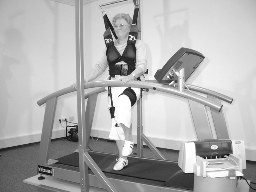
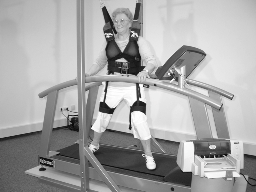
Execution
Patient stands on one leg at slow speed (the leg of the affected hip side). The leg of the healthy hip side is being pulled up by far in this one leg stand, the standing leg „drives“ below the suspension point until the patient can not stand any longer. Followed by a long step forward, after this step the contra-lateral leg is being pulled up quickly (impulse for the abductors of the affected standing leg)
Walking speed, unweighting and exercise duration are selected individually depending on the patient, the injury and the therapy goal.
N Speed: approx. 2-8 km/h
N Exercise duration: approx. 2 min.
N Unweighting: approx. 50% of the bodyweight, slowly reduced
Eye – Foot – Coordination
Aids
Sticky tape / coloured tape bands. Coloured tapes / adhesive marks on the running belt and on the shoes in two different colours (e.g. red for the left foot, green for the right foot). In preparation for this exercise coloured tape marks are placed on the running belt. The marks are placed in irregular distances of 20 to 80 cm and in different positions on the running belt. The sticky marks have to be removed again after the exercise.
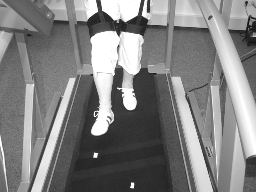
Starting position
With both feet on the side foot plate of the moving running belt, eyes against the running direction of the running belt, various sticky marks on the belt (red – left; green – right) in irregular distances
Execution
Out of the standing position stepping on the marks with the respective foot and back on the foot plate again.
© 2005 h/p/cosmos sports & medical gmbh email@h-p-cosmos.com created 26.09.2005 printed 26.09.2005 page: 27 of 40 LN
Walking speed, unweighting and exercise duration are selected individually depending on the patient, the injury and the therapy goal.
N Speed: approx. 2 - 3 km/h
N Exercise duration: approx. 2 - 3 min.
N Unweighting: 0% bodyweight – little trunk stabilisation
25% bodyweight – significant trunk stabilisation
50% bodyweight – insignificant trunk stabilisation approx. 50% of the bodyweight
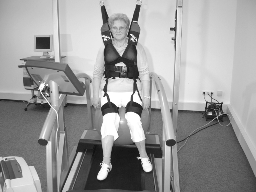
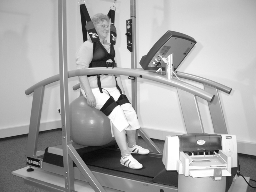
Training goal
Training of the deep stabilisation of the upper body
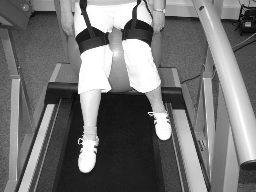
Aids
Aerobic-Step and gymnastics ball. The Aerobic-Step is placed across the running surface like a bridge, the gymnastics ball is place on the step and the patient sits down there for the execution of the exercise.
Starting position
Aerobic –Step, patient sitting on the gymnastics ball on top of the aerobic-step facing against the direction of the running belt, one foot on the running belt, one foot placed on the side foot plate, hands are not placed on the handrails.
Execution
For this exercise the patient is not allowed to hold on to the side handrails. For stabilisation he has to build up a deep tension in the trunk muscles. One leg rests next to the running belt; the other leg is led into a flexion (“seated walking”), without any support from the hands.
The patient has to hold the trunk axis resp. the trunk direction during the exercise.
Variations
1 foot lifted up on the side
© 2005 h/p/cosmos sports & medical gmbh email@h-p-cosmos.com created 26.09.2005 printed 26.09.2005 page: 28 of 40 LN
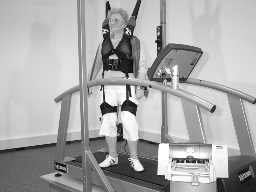
Walking speed, unweighting and exercise duration are selected individually depending on the patient, the injury and the therapy goal.
N Speed: ca. 2-4 km/h
N Exercise duration: approx. 15 min.
N Unweighting: approx. 50% of the bodyweight (depending on pain different traction on the spine)
Exercise goal
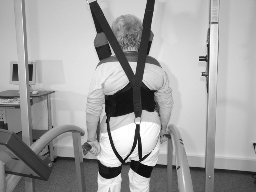
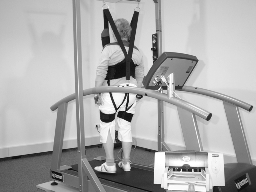
Trunk stabilisation (lower deep stabilisation grows with increasing unweighting up to 50% of the bodyweight) at simultaneous spine-traction and varying pelvis positions depending on the amount of unweighting, pelvis stabilisation via the latissimus dorsi.
Aids
Theraband. The patient holds the band which is stretched over the shoulders in both hands
Starting position
With both feet on the running belt, facing against the running direction, Theraband stretched over both shoulders in both hands (bilateral: extension / abduction/ inwards rotation)
Execution
The patient has to walk slowly and rotate around his own axis for 360 degree. During this exercise he should always stay directly beneath the suspension point of the h/p/cosmos airwalk.
Walking speed, unweighting and exercise duration are selected individually depending on the patient, the injury and the therapy goal.
N Speed: approx. 3 km/h
N Exercise duration: approx. 3 - 5 min.
N Unweighting: approx. 50% of the bodyweight, decrescent as quickly as possible
© 2005 h/p/cosmos sports & medical gmbh email@h-p-cosmos.com created 26.09.2005 printed 26.09.2005 page: 29 of 40 LN
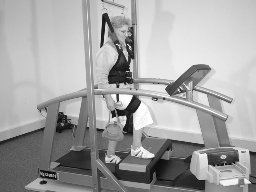
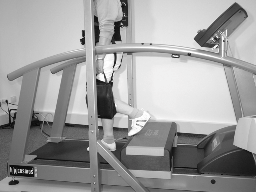
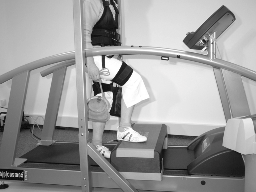
Exercise goal
Train ATL-functions, „sensomotoric disorders, fall training
Starting position
Standing with both feet on the Aerobic-Step, facing in the direction of the running belt, a bag in each hand, the running belt moving.
Execution
Step down from the stair onto the moving running belt and start walking („step onto an escalator“). Turn around on the running belt and step back onto the stair (“climbing stairs”).
© 2005 h/p/cosmos sports & medical gmbh email@h-p-cosmos.com created 26.09.2005 printed 26.09.2005 page: 30 of 40 LN
Walking speed, unweighting and exercise duration are selected individually depending on the patient, the injury and the therapy goal.
N Speed: approx. 0.1 – 0.5 km/h (depending on active cooperation)
N Exercise duration: approx. 2-3 min.
N Unweighting: approx. 50 % of the bodyweight, decrescent, depending on the state of the patient
Exercise goal
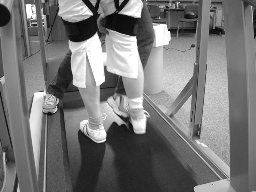
Well-measured locomotion training – start of exercise to check ankle joint mobility
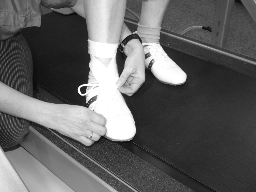
Aids
Pronation tape ( e.g. Smith & Nephew)
Starting position
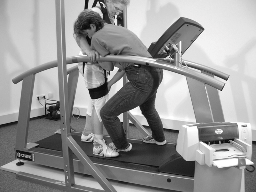
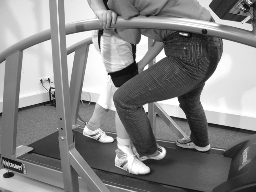
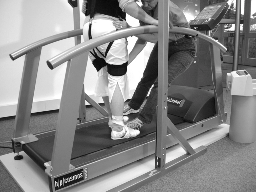
With both feet on the running belt; affected foot fixed with pronation tape to avoid dragging of the foot; affected hand fixed to the handrail with elastic bandage; eyes against running direction
Execution
Slow walking with approximation of the pelvis through the therapist at the front (depending on the weight of the patient maybe second therapist at the feet)
© 2005 h/p/cosmos sports & medical gmbh email@h-p-cosmos.com created 26.09.2005 printed 26.09.2005 page: 31 of 40 LN
Walking speed, unweighting and exercise duration are selected individually depending on the patient, the injury and the therapy goal.
N Speed: approx. 0.1 – 0.5 km/h (depending on active cooperation)
N Exercise duration: approx. 2-3 min.
N Unweighting: approx. 50 % of the bodyweight decrescent, depending on the condition of the patient
Exercise goal
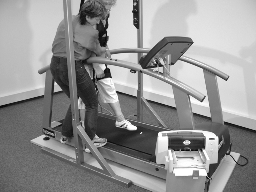
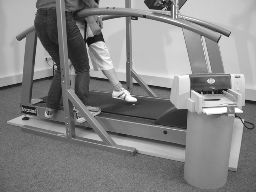
Standing leg exercise for the affected leg (Extension) of a hemiplegic
Aids Pronation tape (e.g. Smith&Nephew),
Starting position
Affected foot on the side foot plate next to the running belt, facing against direction of running belt, coloured tape marks on the running belt
Execution
The patient stands with the affected leg on the side foot plate next to the running belt. The foot of the healthy leg points towards the coloured tape marks on the running belt (flexion during lift-up).
Variation
A Theraband is wrapped around the foot of the healthy side. The therapist trains the standing abilities of the paralyzed side by pulling and guiding different loads on the free leg.
© 2005 h/p/cosmos sports & medical gmbh email@h-p-cosmos.com created 26.09.2005 printed 26.09.2005 page: 32 of 40 LN
Walking speed, unweighting and exercise duration are selected individually depending on the patient, the injury and the therapy goal.
N Speed: approx. 0.1 – 0.5 km/h (depending on the active cooperation)
N Exercise duration: approx. 2-3 min.
N Unweighting: approx. 50 % of the bodyweight decrescent, depending on the condition of the patient
Exercise goal
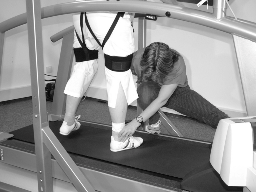
Forced use of the affected leg for the step-trigger-off (free leg)
Starting position
Both feet on the running belt, facing sideward with the paralyzed side against the direction of the running belt
Execution
Lateral walking (putting down), controlled step- trigger-off depending on weight shifting (traction from above)
Forced use of the affected leg as standing leg
Starting position
As stated above, however with the paralyzed side in the direction of the running belt
© 2005 h/p/cosmos sports & medical gmbh email@h-p-cosmos.com created 26.09.2005 printed 26.09.2005 page: 33 of 40 LN
Execution
The patient performs a lateral step at low speed with the leg of the healthy side and afterwards leads the leg of the paralyzed side to a controlled step-trigger-off (safety-step of the better leg)
All exercises as explained previously with increasing duration.
Training goal
The affected body half has to be moved actively more and more.
© 2005 h/p/cosmos sports & medical gmbh email@h-p-cosmos.com created 26.09.2005 printed 26.09.2005 page: 34 of 40 LN
[Silvia Kollos und Dr. Thomas Bochdansky]
BODY WEIGHT SUPPORT TREADMILL TRAINING IMPROVES BLOOD GLUCOSE REGULATION IN PERSONS WITH INCOMPLETE SPINAL CORD
INJURY. Phillips SM, et al.; J Appl Physiol. 2004 Apr 23 [Epub ahead of print]; PMID: 15107410 [PubMed - as supplied by publisher]
LOCOMOTOR ACTIVITY IN SPINAL CORD-INJURED PERSONS. Dietz V, et al.; J Appl Physiol. 2004 May;96(5):1954-1960; PMID: 15075315 [PubMed -
as supplied by publisher]
DISTRIBUTED PLASTICITY OF LOCOMOTOR PATTERN GENERATORS IN SPINAL CORD INJURED PATIENTS. Grasso R, et al.; Brain. 2004
May;127(Pt 5):1019-34. Epub 2004 Feb 26; PMID: 14988161 [PubMed - in process]
TREADMILL TRAINING AND/OR BODY WEIGHT SUPPORT MAY NOT IMPROVE WALKING ABILITY FOLLOWING STROKE. HELBOSTAD. JL.; Aust J
Physiother. 2003;49(4):278. No abstract available. PMID: 14714540 [PubMed]
TREADMILL TRAINING WITH PARTIAL BODY-WEIGHT SUPPORT AFTER TOTAL HIP ARTHROPLASTY: A RANDOMIZED CONTROLLED TRIAL.
Hesse S, et al.; Arch Phys Med Rehabil. 2003 Dec;84(12):1767-73. PMID: 14669181 [PubMed - indexed for MEDLINE]
UPPER AND LOWER EXTREMITY ROBOTIC DEVICES FOR REHABILITATION AND FOR STUDYING MOTOR CONTROL. Hesse S, et al. ; Curr Opin
Neurol. 2003 Dec;16(6):705-10. PMID: 14624080 [PubMed - in process]
TREADMILL TRAINING AND BODY WEIGHT SUPPORT FOR WALKING AFTER STROKE. Moseley AM, et al.; Stroke. 2003 Dec;34(12):3006. Epub 2003
Nov 13. Review. No abstract available. PMID: 14615617 [PubMed - indexed for MEDLINE]
OPTIMAL OUTCOMES OBTAINED WITH BODY-WEIGHT SUPPORT COMBINED WITH TREADMILL TRAINING IN STROKE SUBJECTS. Barbeau H, et
al.; Arch Phys Med Rehabil. 2003 Oct;84(10):1458-65. PMID: 14586912 [PubMed - indexed for MEDLINE]
GAIT RETRAINING POST STROKE. Teasell RW, et al.; Top Stroke Rehabil. 2003 Summer;10(2):34-65. PMID: 13680517 [PubMed - indexed for MEDLINE]
THE EFFECT OF TREADMILL TRAINING ON MOTOR RECOVERY AFTER A PARTIAL SPINAL CORD COMPRESSION-INJURY IN THE ADULT RAT.
Multon S, et al. ; J Neurotrauma. 2003 Aug;20(8):699-706. PMID: 12965049 [PubMed - indexed for MEDLINE]
TREADMILL TRAINING AND BODY WEIGHT SUPPORT FOR WALKING AFTER STROKE. Moseley AM, et al.; Cochrane Database Syst Rev. 2003;(3):CD002840. Review. PMID: 12917932 [PubMed - indexed for MEDLINE]
TEMPORAL COMPONENTS OF THE MOTOR PATTERNS EXPRESSED BY THE HUMAN SPINAL CORD REFLECT FOOT KINEMATICS. Ivanenko YP,
et al.; J Neurophysiol. 2003 Nov;90(5):3555-65. Epub 2003 Jul 09. PMID: 12853436 [PubMed - indexed for MEDLINE]
THE EFFECT OF TREADMILL TRAINING ON GAIT, BALANCE AND TRUNK CONTROL IN A HEMIPLEGIC SUBJECT: A SINGLE SYSTEM DESIGN.
Mudge S, et al.; Disabil Rehabil. 2003 Sep 2;25(17):1000-7. PMID: 12851089 [PubMed - indexed for MEDLINE]
TEMPOROSPATIAL AND KINEMATIC GAIT ALTERATIONS DURING TREADMILL WALKING WITH BODY WEIGHT SUSPENSION. Threlkeld AJ, et al.;
Gait Posture. 2003 Jun;17(3):235-45. PMID: 12770637 [PubMed - indexed for MEDLINE]
TREADMILL TRAINING WITH PARTIAL BODY WEIGHT SUPPORT AFTER STROKE. Hesse S, et al.; Phys Med Rehabil Clin N Am. 2003 Feb;14(1
Suppl):S111-23. Review. PMID: 12625641 [PubMed - indexed for MEDLINE]
EXERCISE CAPACITY EARLY AFTER STROKE. Mackay-Lyons MJ, et al.; Arch Phys Med Rehabil. 2002 Dec;83(12):1697-702. PMID: 12474172 [PubMed
- indexed for MEDLINE]
TREADMILL TRAINING WITH PARTIAL BODY WEIGHT SUPPORT AND AN ELECTROMECHANICAL GAIT TRAINER FOR RESTORATION OF GAIT IN SUBACUTE STROKE PATIENTS: A RANDOMIZED CROSSOVER STUDY. Werner C, et al.; Stroke. 2002 Dec;33(12):2895-901. PMID: 12468788
[PubMed - indexed for MEDLINE]
REHA-STEPPER LOCOMOTION THERAPY IN EARLY REHABILITATION OF PARAPLEGIC PATIENTS
Rupp R, et al.; Biomed Tech (Berl). 2002;47 Suppl 1 Pt 2:708-11. German. PMID: 12465280 [PubMed - indexed for MEDLINE]
TREADMILL TRAINING WITH PARTIAL BODY WEIGHT SUPPORT AND PHYSIOTHERAPY IN STROKE PATIENTS: A PRELIMINARY COMPARISON.
Werner C, et al.; Eur J Neurol. 2002 Nov;9(6):639-44. PMID: 12453080 [PubMed - indexed for MEDLINE]
RECRUITMENT OF SPINAL MOTOR POOLS DURING VOLUNTARY MOVEMENTS VERSUS STEPPING AFTER HUMAN SPINAL CORD INJURY.
Maegele M, et al.; J Neurotrauma. 2002 Oct;19(10):1217-29. PMID: 12427330 [PubMed - indexed for MEDLINE]
PREMOTOR CORTEX IS INVOLVED IN RESTORATION OF GAIT IN STROKE. Miyai I, et al.; Ann Neurol. 2002 Aug;52(2):188-94. PMID: 12210789
[PubMed - indexed for MEDLINE]
IMPROVED INTRALIMB COORDINATION IN PEOPLE WITH INCOMPLETE SPINAL CORD INJURY FOLLOWING TRAINING WITH BODY WEIGHT SUPPORT AND ELECTRICAL STIMULATION. Field-Fote EC, et al.; Phys Ther. 2002 Jul;82(7):707-15. PMID: 12088467 [PubMed - indexed for MEDLINE]
CONTROL OF FOOT TRAJECTORY IN HUMAN LOCOMOTION: ROLE OF GROUND CONTACT FORCES IN SIMULATED REDUCED GRAVITY.
Ivanenko YP, et al.; J Neurophysiol. 2002 Jun;87(6):3070-89. PMID: 12037209 [PubMed - indexed for MEDLINE]
TREADMILL AMBULATION WITH PARTIAL BODY WEIGHT SUPPORT FOR THE TREATMENT OF LOW BACK AND LEG PAIN. Joffe D, et al.; J Orthop
Sports Phys Ther. 2002 May;32(5):202-13; discussion 213-5. PMID: 12014824 [PubMed - indexed for MEDLINE]
STEP TRAINING WITH BODY WEIGHT SUPPORT: EFFECT OF TREADMILL SPEED AND PRACTICE PARADIGMS ON POSTSTROKE LOCOMOTOR
RECOVERY. Sullivan KJ, et al.; Arch Phys Med Rehabil. 2002 May;83(5):683-91. PMID: 11994808 [PubMed - indexed for MEDLINE]
SUPPORTED TREADMILL TRAINING FOR GAIT AND BALANCE IN A PATIENT WITH PROGRESSIVE SUPRANUCLEAR PALSY.
Suteerawattananon M, et al.; Phys Ther. 2002 May; 82(5):485-95. PMID: 11991801 [PubMed - indexed for MEDLINE]
GAIT TRAINING IN HEMIPLEGIA. Mauritz KH.; Eur J Neurol. 2002 May;9 Suppl 1:23-9; dicussion 53-61. Review. PMID: 11918646 [PubMed - indexed for MEDLINE]
BODY WEIGHT SUPPORTED TREADMILL AND OVERGROUND TRAINING IN A PATIENT POST CEREBROVASCULAR ACCIDENT. Miller EW.
NeuroRehabilitation. 2001;16(3):155-63. PMID: 11790900 [PubMed - indexed for MEDLINE]
LOCOMOTOR THERAPY IN NEUROREHABILITATION. Hesse S.; NeuroRehabilitation. 2001;16(3):133-9. PMID: 11790898 [PubMed - indexed for MEDLINE]
BODY WEIGHT SUPPORT TREADMILL AND OVERGROUND AMBULATION TRAINING FOR TWO PATIENTS WITH CHRONIC DISABILITY
SECONDARY TO STROKE. Miller EW, et al.; Phys Ther. 2002 Jan;82(1):53-61. PMID: 11784278 [PubMed - indexed for MEDLINE]
EFFECT OF 15% BODY WEIGHT SUPPORT ON EXERCISE CAPACITY OF ADULTS WITHOUT IMPAIRMENTS. MacKay-Lyons M, et al.; Phys Ther. 2001 Nov;81(11):1790-800. PMID: 11694172 [PubMed - indexed for MEDLINE]
INFLUENCE OF WALKING SPEED ON LOWER LIMB MUSCLE ACTIVITY AND ENERGY CONSUMPTION DURING TREADMILL WALKING OF
HEMIPARETIC PATIENTS. Hesse S, et al.; Arch Phys Med Rehabil. 2001 Nov;82(11):1547-50. PMID: 11689974 [PubMed - indexed for MEDLINE]
WALKING TRAINING OF PATIENTS WITH HEMIPARESIS AT AN EARLY STAGE AFTER STROKE: A COMPARISON OF WALKING TRAINING ON A TREADMILL WITH BODY WEIGHT SUPPORT AND WALKING TRAINING ON THE GROUND. Nilsson L, et al. ; Clin Rehabil. 2001 Oct;15(5):515-27.
PMID: 11594641 [PubMed - indexed for MEDLINE]
ACUTE EFFECTS OF LOCOMOTOR TRAINING ON OVERGROUND WALKING SPEED AND H-REFLEX MODULATION IN INDIVIDUALS WITH
INCOMPLETE SPINAL CORD INJURY. Trimble MH, et al.; J Spinal Cord Med. 2001 Summer;24(2):74-80. PMID: 11587422 [PubMed - indexed for MEDLINE]
MODULATION OF LOCOMOTOR-LIKE EMG ACTIVITY IN SUBJECTS WITH COMPLETE AND INCOMPLETE SPINAL CORD INJURY. Dobkin BH, et al.;
J Neurol Rehabil. 1995;9(4):183-90. PMID: 11539274 [PubMed - indexed for MEDLINE]
BODY WEIGHT-SUPPORTED TREADMILL TRAINING AFTER STROKE. Hesse S, et al.; Curr Atheroscler Rep. 2001 Jul;3(4):287-94. Review. PMID:
11389793 [PubMed - indexed for MEDLINE]
COMBINED USE OF BODY WEIGHT SUPPORT, FUNCTIONAL ELECTRIC STIMULATION, AND TREADMILL TRAINING TO IMPROVE WALKING ABILITY IN INDIVIDUALS WITH CHRONIC INCOMPLETE SPINAL CORD INJURY. Field-Fote EC.; Arch Phys Med Rehabil. 2001 Jun;82(6):818-24. PMID:
11387589 [PubMed - indexed for MEDLINE]
EQUIPMENT SPECIFICATIONS FOR SUPPORTED TREADMILL AMBULATION TRAINING. Wilson MS, et al.; J Rehabil Res Dev. 2000 Jul- Aug;37(4):415-22. PMID: 11028697 [PubMed - indexed for MEDLINE
OXYGEN CONSUMPTION DURING TREADMILL WALKING WITH AND WITHOUT BODY WEIGHT SUPPORT IN PATIENTS WITH HEMIPARESIS
AFTER STROKE AND IN HEALTHY SUBJECTS. Danielsson A, et al.; Arch Phys Med Rehabil. 2000 Jul;81(7):953-7. PMID: 10896011 [PubMed - indexed for MEDLINE]
TREADMILL TRAINING WITH BODY WEIGHT SUPPORT: ITS EFFECT ON PARKINSON'S DISEASE. Miyai I, et al.; Arch Phys Med Rehabil. 2000 Jul;81(7):849-52. PMID: 10895994 [PubMed - indexed for MEDLINE]
TREADMILL TRAINING WITH PARTIAL BODY WEIGHT SUPPORT IN NONAMBULATORY PATIENTS WITH CEREBRAL PALSY. Schindl MR, et al.;
Arch Phys Med Rehabil. 2000 Mar;81(3):301-6. PMID: 10724074 [PubMed - indexed for MEDLINE]
ELECTROMYOGRAPHIC ANALYSIS AND ENERGY EXPENDITURE OF HARNESS SUPPORTED TREADMILL WALKING: IMPLICATIONS FOR KNEE
REHABILITATION. Colby SM, et al.; Gait Posture. 1999 Dec;10(3):200-5. PMID: 10567751 [PubMed - indexed for MEDLINE]
LAUFBAND (TREADMILL) THERAPY IN INCOMPLETE PARAPLEGIA AND TETRAPLEGIA. Wernig A, et al.; J Neurotrauma. 1999 Aug;16(8):719-26.
PMID: 10511245 [PubMed - indexed for MEDLINE]
GAIT PATTERN OF SEVERELY DISABLED HEMIPARETIC SUBJECTS ON A NEW CONTROLLED GAIT TRAINER AS COMPARED TO ASSISTED TREADMILL WALKING WITH PARTIAL BODY WEIGHT SUPPORT. Hesse S, et al.; Clin Rehabil. 1999 Oct;13(5):401-10. PMID: 10498347 [PubMed -
indexed for MEDLINE]
THE GAIT OF PATIENTS WITH FULL WEIGHTBEARING CAPACITY AFTER HIP PROSTHESIS IMPLANTATION ON THE TREADMILL WITH PARTIAL BODY WEIGHT SUPPORT, DURING ASSISTED WALKING AND WITHOUT CRUTCHES; Hesse S, et al.Z Orthop Ihre Grenzgeb. 1999 May-
Jun;137(3):265-72. German; PMID: 10441834 [PubMed - indexed for MEDLINE]
TREADMILL WALKING WITH PARTIAL BODY WEIGHT SUPPORT VERSUS FLOOR WALKING IN HEMIPARETIC SUBJECTS. Hesse S, et al.; Arch
Phys Med Rehabil. 1999 Apr;80(4):421-7. PMID: 10206604 [PubMed - indexed for MEDLINE]
A NEW APPROACH TO RETRAIN GAIT IN STROKE PATIENTS THROUGH BODY WEIGHT SUPPORT AND TREADMILL STIMULATION. Visintin M, et
al. ; Stroke. 1998 Jun;29(6):1122-8. PMID: 9626282 [PubMed - indexed for MEDLINE]
PARTIAL BODY WEIGHT SUPPORT WITH TREADMILL LOCOMOTION TO IMPROVE GAIT AFTER INCOMPLETE SPINAL CORD INJURY: A SINGLE- SUBJECT EXPERIMENTAL DESIGN. Gardner MB, et al.; Phys Ther. 1998 Apr;78(4):361-74. PMID: 9555919 [PubMed - indexed for MEDLINE]
HUMAN LUMBOSACRAL SPINAL CORD INTERPRETS LOADING DURING STEPPING. Harkema SJ, et al.; J Neurophysiol. 1997 Feb;77(2):797-811.
PMID: 9065851 [PubMed - indexed for MEDLINE]
MECHANICAL UNWEIGHTING EFFECTS ON TREADMILL EXERCISE AND PAIN IN ELDERLY PEOPLE WITH OSTEOARTHRITIS OF THE KNEE.
Mangione KK, et al.; Phys Ther. 1996 Apr;76(4):387-94. PMID: 8606901 [PubMed - indexed for MEDLINE]
RESTORATION OF GAIT BY COMBINED TREADMILL TRAINING AND MULTICHANNEL ELECTRICAL STIMULATION IN NON-AMBULATORY
HEMIPARETIC PATIENTS. Hesse S, et al.; Scand J Rehabil Med. 1995 Dec;27(4):199-204. PMID: 8650503 [PubMed - indexed for MEDLINE]
A TREADMILL APPARATUS AND HARNESS SUPPORT FOR EVALUATION AND REHABILITATION OF GAIT. Norman KE, et al.; Arch Phys Med
Rehabil. 1995 Aug;76(8):772-8. PMID: 7632134 [PubMed - indexed for MEDLINE]
TREADMILL TRAINING WITH PARTIAL BODY WEIGHT SUPPORT COMPARED WITH PHYSIOTHERAPY IN NONAMBULATORY HEMIPARETIC
PATIENTS. Hesse S, et al.; Stroke. 1995 Jun;26(6):976-81. PMID: 7762049 [PubMed - indexed for MEDLINE]
LAUFBAND THERAPY BASED ON 'RULES OF SPINAL LOCOMOTION' IS EFFECTIVE IN SPINAL CORD INJURED PERSONS. Wernig A, et al.; Eur J
Neurosci. 1995 Apr 1;7(4):823-9. Erratum in: Eur J Neurosci 1995 Jun 1;7(6):1429. PMID: 7620630 [PubMed - indexed for MEDLINE]
RESTORATION OF GAIT IN NONAMBULATORY HEMIPARETIC PATIENTS BY TREADMILL TRAINING WITH PARTIAL BODY-WEIGHT SUPPORT.
Hesse S, et al.; Arch Phys Med Rehabil. 1994 Oct;75(10):1087-93. PMID: 7944913 [PubMed - indexed for MEDLINE]
THE EFFECTS OF PARALLEL BARS, BODY WEIGHT SUPPORT AND SPEED ON THE MODULATION OF THE LOCOMOTOR PATTERN OF SPASTIC
PARETIC GAIT. A PRELIMINARY COMMUNICATION. Visintin M, et al.; Paraplegia. 1994 Aug;32(8):540-53. PMID: 7970859 [PubMed - indexed for MEDLINE]
LAUFBAND LOCOMOTION WITH BODY WEIGHT SUPPORT IMPROVED WALKING IN PERSONS WITH SEVERE SPINAL CORD INJURIES. Wernig A,
et al.; Paraplegia. 1992 Apr;30(4):229-38. PMID: 1625890 [PubMed - indexed for MEDLINE]
INFLUENCE OF BODY WEIGHT SUPPORT ON NORMAL HUMAN GAIT: DEVELOPMENT OF A GAIT RETRAINING STRATEGY. Finch L, et al.; Phys
Ther. 1991 Nov;71(11):842-55; discussion 855-6. PMID: 1946621 [PubMed - indexed for MEDLINE]
THE COMBINED EFFECTS OF CLONIDINE AND CYPROHEPTADINE WITH INTERACTIVE TRAINING ON THE MODULATION OF LOCOMOTION IN SPINAL CORD INJURED SUBJECTS. Fung J, et al.; J Neurol Sci. 1990 Dec;100(1-2):85-93. PMID: 2089144 [PubMed - indexed for MEDLINE]
THE EFFECTS OF CYPROHEPTADINE ON LOCOMOTION AND ON SPASTICITY IN PATIENTS WITH SPINAL CORD INJURIES. Wainberg M, et al. ; J
Neurol Neurosurg Psychiatry. 1990 Sep;53(9):754-63. PMID: 2246657 [PubMed - indexed for MEDLINE]
THE EFFECTS OF BODY WEIGHT SUPPORT ON THE LOCOMOTOR PATTERN OF SPASTIC PARETIC PATIENTS. Visintin M, et al.; Can J Neurol Sci. 1989 Aug;16(3):315-25. PMID: 2766124 [PubMed - indexed for MEDLINE]
This section summarizes the different approaches taken by experimenters applying harness-supported treadmill training to neurologically impaired subjects and the current status of work quantifying the immediate gait response (i.e., gait kinematics, temporal-distance parameters, and symmetry measures) of normal and neurologically impaired subjects to the training technique. Of the three training parameters proposed (i.e., body weight support, treadmill speed, and harness-support compliance), only the effect of treadmill speed on training outcomes has been studied. This study on training speed by Sullivan et al. (2000) is summarized, along with some preliminary work and opinions on harness-support compliance.
Many approaches have been used to prescribe body weight support, treadmill speed, and manual assistance in the application of harness- supported treadmill training. Hesse et al. (1995) set initial body weight support to 30% based on clinical experience, and reduced it as rapidly as possible to ensure full weight bearing. Treadmill speed was kept deliberately slow to permit longer training sessions and facilitate gait corrections using manual assistance (Hesse et al., 1995). Gardner et al. (1998) set body weight support to the highest level that allowed the subject to achieve heel contact for 10 consecutive steps and maintained this level throughout the study. Treadmill speed was increased in 0.5 mph increments when the subject was able to ambulate without scuffing the paretic foot for 10 consecutive steps during the maximum speed in the prior session (Gardner et al., 1998). Manual assistance was not provided in this study since the subject was able to ambulate independently (Gardner et al., 1998). Visintin et al. (1998) observed subjects walking at 10%, 20%, 30%, and 40% body weight support and selected the percent body weight support that facilitated proper trunk and limb alignment and transfer of weight onto the hemiparetic limb.
One or two therapists provided manual assistance, as needed (Visintin et al., 1998). Body weight support was reduced and treadmill speed increased in a stepwise manner as the subject’s walking ability improved (Visintin et al., 1998). Seif-Naraghi and Herman (1999) described a number of training approaches, including one that advocated training subjects at the fastest possible speed with as much help from the device and experimenters as needed. Considerable latitude exists in the application of harness-supported treadmill training because subjects are capable of walking at different training parameter settings and with variable amounts of manual assistance during training sessions. Experimenters can choose to reduce body weight support as rapidly as possible or give training speed a higher priority. Manual assistance can be provided only when absolutely necessary (subject cannot practice stepping) or whenever the subject is not producing the “desired” gait kinematics. However, it’s often unclear when optimal gait kinematics and, particularly, gait kinetics are produced as training parameters are adjusted.
Gait kinematics have been reported during harness-supported treadmill walking in spastic paretic (Visintin and Barbeau, 1989), hemiparetic (Hesse et al., 1997), and neurologically healthy subjects (Finch et al., 1991). In these studies, joint angular displacements were assessed manually from the monitor screen with the aid of reflective markers (Finch et al., 1991; Visintin and Barbeau, 1989) or qualitatively by raters (Hesse et al., 1997). At 15-60% body weight support, both spastic paretic (Visintin and Barbeau, 1989) and hemiparetic (Hesse et al., 1997) subjects walked more upright with straighter hip and knee alignment during stance. At up to 45% body weight support, the authors noted more normal joint angular displacement profiles (Visintin and Barbeau, 1989) and a more physiologic, plantigrade manner of weight acceptance (Hesse et al., 1997). However, at 60% body weight support, hemiparetic subjects tended to walk on their toes, particularly with the non-paretic limb (Hesse et al., 1997).
This amount of body weight support was therefore regarded as unfavorable by the authors (Hesse et al., 1997). Interestingly, body weight support also decreased hip and knee flexion during swing (Hesse et al., 1997). Straighter hip and knee alignment during stance and decreased hip and knee flexion during swing were also observed in neurologically healthy subjects walking with body weight support (Finch et al., 1991). The authors noted that harness constraints limiting the downward excursion of the center of gravity might have contributed to these changes (Finch et al., 1991). Indeed, trunk height was found to increase with body weight support (Finch et al., 1991). The authors also speculated that a decrease in kinetic energy transfer during terminal stance, resulting in decreased swing momentum and displacement, might have contributed to the decreased hip and knee flexion observed during swing (Finch et al., 1991).
© 2005 h/p/cosmos sports & medical gmbh email@h-p-cosmos.com created 26.09.2005 printed 26.09.2005 page: 38 of 40 LN
Temporal-distance and symmetry measures during harness-supported treadmill walking have been determined using foot switches (Finch et al., 1991; Hassid et al., 1997; Visintin and Barbeau, 1989) or instrumented overshoe slippers (Hesse et al., 1997; Hesse et al., 1999). In spastic paretic (Visintin and Barbeau, 1989), hemiparetic (Hesse et al., 1997; Hesse et al., 1999), and neurologically healthy subjects (Finch et al., 1991), single limb support time increased (particularly, in the paretic limb(s)) and relative double support time decreased with body weight support. The authors suggested that body weight support might provide a greater stimulus for balance training since single limb support requires the paretic limb to both balance and bear weight while the contralateral limb is in swing (Finch et al., 1991; Hesse et al., 1997; Hesse et al., 1999; Visintin and Barbeau, 1989). Visintin et al. (1989) also reported increased stride length and maximum comfortable walking speed with body weight support.
In two studies on hemiparetic subjects by Hesse et al. (1997; 1999), swing symmetry increased with body weight support, but stance, double limb support, and step length symmetry were not affected. However, stance symmetry was greater while walking on the treadmill than walking overground (Hesse et al., 1999). Hassid et al. (1997) reported greater single limb stance symmetry (a measure equivalent to swing symmetry) in hemiparetic subjects while walking on a treadmill as compared to walking overground. Interestingly, this increase in symmetry occurred even at 0% body weight support in some subjects (Hassid et al., 1997). Nevertheless, single limb stance symmetry improved most consistently at 15-30% body weight support and was disrupted at 50% body weight support in some subjects (Hassid et al., 1997). Higher belt speeds did not alter this general improvement in symmetry on the treadmill (Hassid et al., 1997). The authors suggested that treadmill walking might allow hemiparetic subjects to receive more normal and symmetrical step-related sensory feedback, which could enhance locomotion (Hassid et al., 1997).
Vertical ground reaction forces and center of mass movement have been measured in spinal cord injured and neurologically healthy subjects as they walked on a treadmill with their weight partially supported by a rigid cable or compliant pneumatic cylinder (Gordon et al., 2000). Support by a rigid cable was found to restrict vertical center of mass movement and reduce peaks in vertical ground reaction force at heel strike and toe off (Gordon et al., 2000). Support by a compliant pneumatic cylinder allowed vertical center of mass movement similar to overground locomotion, but peaks in vertical ground reaction force at heel strike were abnormally greater than at toe off (Gordon et al., 2000). The abnormal vertical ground reaction forces may have been due to viscosity in the pneumatic system since support force still fluctuated with trunk motion. A dynamic regulator was later added to the pneumatic system, which reduced body weight support fluctuation during the gait cycle and allowed vertical ground reaction forces comparable to overground gait adjusted for body weight support (Gordon et al., 2000).
The authors concluded that the body weight support system affects center of mass movement and vertical ground reaction forces, which could influence afferent information important to training (Gordon et al., 2000). Wilson et al. (2000) provided equipment specifications on the body weight support system based on clinical feedback and the application of engineering principles. The authors believed a system that does not allow vertical displacement produces an unnatural form of gait, which is not the goal of therapy (Wilson et al., 2000). They recommended a Hooke’s law spring system with a stiffness of about 880 N/m, reasoning that it would allow enough vertical motion for normal gait, but not enough to allow the patient to lose posture (Wilson et al., 2000). Moreover, the increase in support when the spring is stretched could provide more feedback and reassurance to patients and a smoother safety catch if they should fall (Wilson et al., 2000).
One study has compared the effectiveness of harness-supported treadmill training using different training speeds. Sullivan et al. (2000) randomly assigned 24 individuals with unilateral stroke to slow (0.5 mph), fast (2.0 mph), and variable (0.5, 1.0, 1.5, 2.0 mph) speed training groups. The subjects received 20 minutes of harness-supported treadmill training for 12 sessions across 4-5 weeks at the prescribed treadmill speed(s) (Sullivan et al., 2000). Even though all groups improved their self-selected overground walking velocity after the training phase, significantly greater improvement occurred in the fast training group (Sullivan et al., 2000). The authors concluded that training speed might be a practice parameter that enhances the effectiveness of harness-supported treadmill training (Sullivan et al., 2000).
© 2005 h/p/cosmos sports & medical gmbh email@h-p-cosmos.com created 26.09.2005 printed 26.09.2005 page: 39 of 40 LN
For orders or in case of error reports please always mention the device code, the serial number of the h/p/cosmos device and the delivery date. Use the following telephone- and fax numbers as well as email addresses if you have any questions concerning delivery dates, service, orders for consumable etc.
phone +49 / 86 69 / 86 42 25
fax +49 / 86 69 / 86 42 49
phone +49 / 86 69 / 86 42 0
fax +49 / 86 69 / 86 42 49
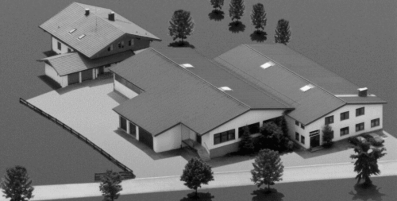
h/p/cosmos sports & medical gmbh
Am Sportplatz 8
DE 83365 Nussdorf-Traunstein Germany
phone +49 / 86 69 / 86 42 0
fax +49 / 86 69 / 86 42 49
email@h-p-cosmos.com www.h-p-cosmos.com
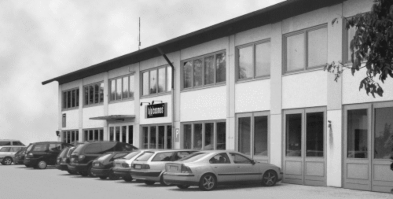
Building 1
h/p/cosmos development & production Am Sportplatz 8
DE 83365 Nussdorf-Traunstein
Building 2
h/p/cosmos sales & service Feldschneiderweg 5
DE 83365 Nussdorf-Traunstein
© 2005 h/p/cosmos sports & medical gmbh email@h-p-cosmos.com created 26.09.2005 printed 26.09.2005 page: 40 of 40 LN